ROC Curve
A Receiver Operating Characteristic (ROC) curve plots the true positive rate (sensitivity) against the false positive rate (1 − specificity) as the classification threshold is swept from high to low. The area under the curve (AUC) summarises discrimination ability in a single number; AUC = 1.0 is perfect, AUC = 0.5 is no better than chance.
RocPlot supports multiple classifiers on one canvas, DeLong 95% confidence intervals, Youden's J optimal threshold marker, and partial AUC restricted to a FPR sub-range.
Import path: kuva::plot::{RocPlot, RocGroup}
Basic usage
Build one RocGroup per classifier using .with_raw(), which accepts (score, bool) pairs. Pass raw scores — RocGroup computes the curve and AUC internally.
Each distinct score value gets its own ROC threshold, even if two values are very close. AUC is the fraction of positive-negative pairs in which the positive sample has the higher score, with equal-score pairs counting as half a win. A group with a NaN score has no curve or AUC, because NaN cannot be ordered.
#![allow(unused)]
fn main() {
use kuva::plot::{RocPlot, RocGroup};
use kuva::backend::svg::SvgBackend;
use kuva::render::render::render_multiple;
use kuva::render::layout::Layout;
use kuva::render::plots::Plot;

/// Deterministic (score, label) dataset from logistic quantiles.
/// n positive samples drawn from Logistic(+mu, scale),
/// n negative from Logistic(-mu, scale), mapped to [0,1] via sigmoid.
fn logistic_dataset(n: usize, mu: f64, scale: f64) -> Vec<(f64, bool)> {
    let mut data = Vec::with_capacity(2 * n);
    for i in 1..=n {
        let p = i as f64 / (n + 1) as f64;
        let logit = (p / (1.0 - p)).ln();
        let pos = 1.0 / (1.0 + (-(mu + scale * logit)).exp());
        let neg = 1.0 / (1.0 + (-(-mu + scale * logit)).exp());
        data.push((pos, true));
        data.push((neg, false));
    }
    data
}

let group = RocGroup::new("Classifier")
    .with_raw(logistic_dataset(150, 1.0, 0.5));

let roc = RocPlot::new().with_group(group);

let plots = vec![Plot::Roc(roc)];
let layout = Layout::auto_from_plots(&plots)
    .with_title("ROC Curve")
    .with_x_label("False Positive Rate")
    .with_y_label("True Positive Rate");

let scene = render_multiple(plots, layout);
let svg = SvgBackend.render_scene(&scene);
std::fs::write("roc.svg", svg).unwrap();
}
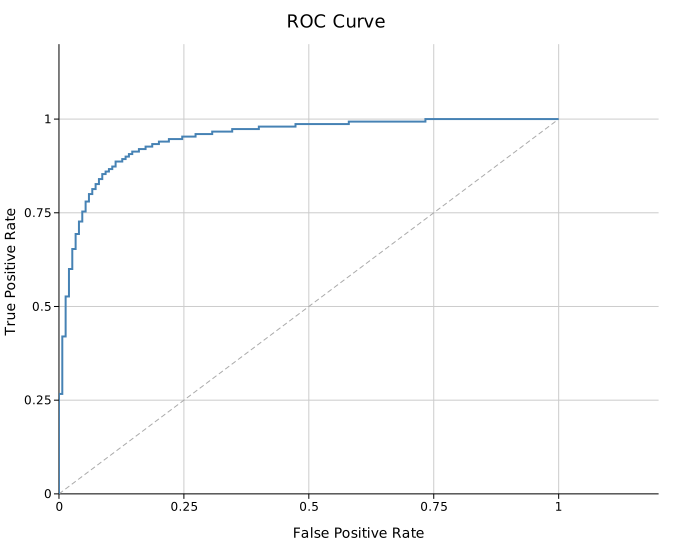
The AUC is shown in the legend by default. The dashed diagonal represents a random classifier (AUC = 0.5). Both can be suppressed — see the API reference below.
DeLong 95% confidence interval
.with_ci(true) on a RocGroup shades the DeLong 95% CI band around the curve. The DeLong estimator is computed from the raw (score, label) pairs and requires no bootstrap.
#![allow(unused)]
fn main() {
use kuva::plot::{RocPlot, RocGroup};
use kuva::render::plots::Plot;
fn logistic_dataset(n: usize, mu: f64, scale: f64) -> Vec<(f64, bool)> { vec![] }
let group = RocGroup::new("Classifier")
    .with_raw(logistic_dataset(150, 1.0, 0.5))
    .with_ci(true)
    .with_optimal_point();   // also mark the Youden J point

let roc = RocPlot::new().with_group(group);
let plots = vec![Plot::Roc(roc)];
}
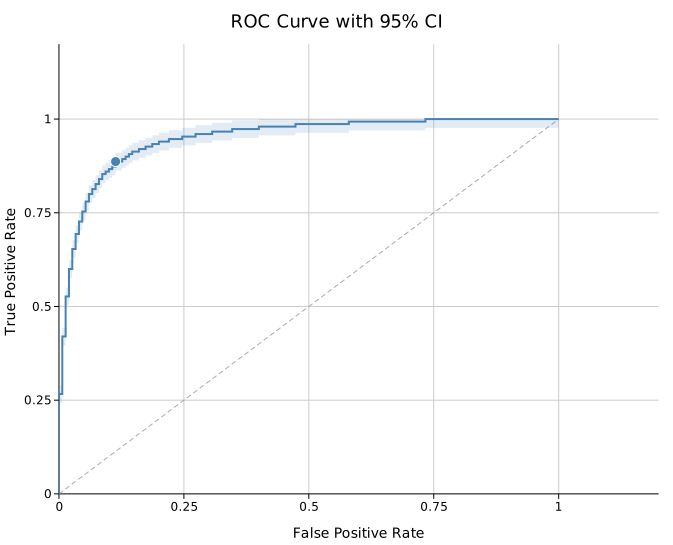
.with_ci_alpha(f) controls the band opacity (default 0.15). The CI is only available with .with_raw() input — pre-computed point data uses only the trapezoidal AUC, and the CI is not shown.
Optimal threshold (Youden's J)
.with_optimal_point() marks the threshold that maximises Youden's J statistic, defined as J = TPR − FPR. The marked point gives the operating point with the best trade-off between sensitivity and specificity.
#![allow(unused)]
fn main() {
use kuva::plot::{RocPlot, RocGroup};
use kuva::render::plots::Plot;
fn logistic_dataset(n: usize, mu: f64, scale: f64) -> Vec<(f64, bool)> { vec![] }
let group = RocGroup::new("Biomarker A")
    .with_raw(logistic_dataset(120, 1.1, 0.45))
    .with_optimal_point();
}
The marker is rendered as a filled circle. Its (FPR, TPR) coordinates correspond to the sensitivity and specificity at that threshold: sensitivity = TPR, specificity = 1 − FPR.
To display the exact numeric values, combine with a stats box (see Stats Box):
#![allow(unused)]
fn main() {
use kuva::render::layout::Layout;
use kuva::plot::legend::LegendPosition;
use kuva::render::plots::Plot;
let plots: Vec<Plot> = vec![];

// After computing sensitivity/specificity at your chosen threshold:
let layout = Layout::auto_from_plots(&plots)
    .with_title("Biomarker")
    .with_x_label("1 − Specificity")
    .with_y_label("Sensitivity")
    .with_stats_box_at(
        LegendPosition::InsideBottomRight,
        vec!["Sensitivity = 0.843", "Specificity = 0.779"],
    );
}
Multi-model comparison
Add one RocGroup per model. Colors are drawn automatically from the palette; attach .with_legend() on the RocPlot to show a legend title.
#![allow(unused)]
fn main() {
use kuva::plot::{RocPlot, RocGroup};
use kuva::backend::svg::SvgBackend;
use kuva::render::render::render_multiple;
use kuva::render::layout::Layout;
use kuva::render::plots::Plot;

fn logistic_dataset(n: usize, mu: f64, scale: f64) -> Vec<(f64, bool)> { vec![] }
let g1 = RocGroup::new("Model A").with_raw(logistic_dataset(150, 1.2, 0.5));
let g2 = RocGroup::new("Model B").with_raw(logistic_dataset(150, 0.6, 0.5));
let g3 = RocGroup::new("Model C").with_raw(logistic_dataset(150, 0.2, 0.5));

let roc = RocPlot::new()
    .with_group(g1)
    .with_group(g2)
    .with_group(g3)
    .with_legend("Classifier");

let plots = vec![Plot::Roc(roc)];
let layout = Layout::auto_from_plots(&plots)
    .with_title("Multi-model ROC Comparison")
    .with_x_label("False Positive Rate")
    .with_y_label("True Positive Rate");

let svg = SvgBackend.render_scene(&render_multiple(plots, layout));
}
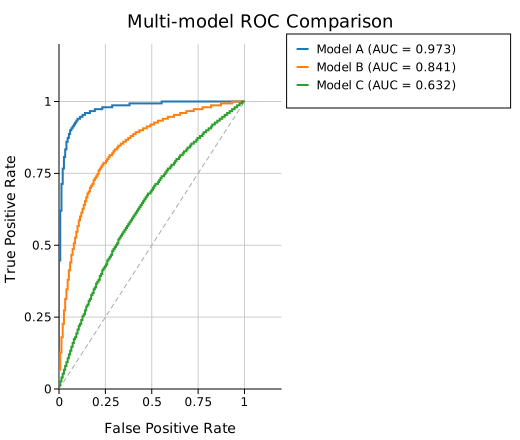
Each entry in the legend automatically appends the AUC value (e.g. Model A (AUC = 0.88)). Suppress this with .with_auc_label(false) on any group.
Diagnostic biomarker comparison with CI
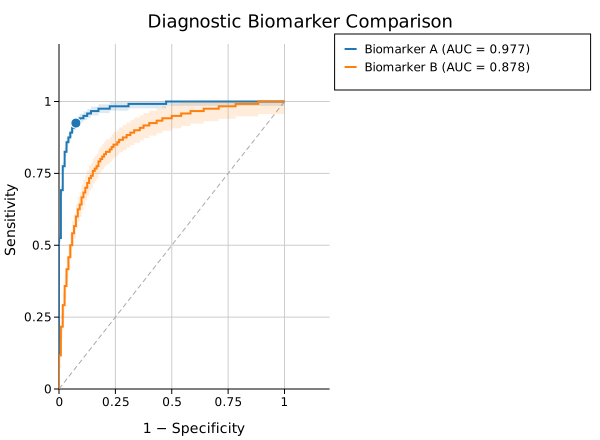
A common bioinformatics use case: comparing two biomarkers on the same cohort with confidence bands to assess whether the difference in AUC is meaningful.
#![allow(unused)]
fn main() {
use kuva::plot::{RocPlot, RocGroup};
use kuva::backend::svg::SvgBackend;
use kuva::render::render::render_multiple;
use kuva::render::layout::Layout;
use kuva::render::plots::Plot;

fn logistic_dataset(n: usize, mu: f64, scale: f64) -> Vec<(f64, bool)> { vec![] }
let g1 = RocGroup::new("Biomarker A")
    .with_raw(logistic_dataset(120, 1.1, 0.45))
    .with_ci(true)
    .with_optimal_point();

let g2 = RocGroup::new("Biomarker B")
    .with_raw(logistic_dataset(120, 0.7, 0.5))
    .with_ci(true);

let roc = RocPlot::new()
    .with_group(g1)
    .with_group(g2)
    .with_legend("Biomarker");

let plots = vec![Plot::Roc(roc)];
let layout = Layout::auto_from_plots(&plots)
    .with_title("Diagnostic Biomarker Comparison")
    .with_x_label("1 − Specificity")
    .with_y_label("Sensitivity");

let svg = SvgBackend.render_scene(&render_multiple(plots, layout));
}
Partial AUC
.with_pauc(fpr_lo, fpr_hi) restricts the AUC calculation to a FPR sub-range. This is useful in clinical settings where only low false-positive-rate operating points are clinically relevant. The partial AUC is normalised to the width of the range so that a perfect classifier still gives 1.0.
#![allow(unused)]
fn main() {
use kuva::plot::{RocPlot, RocGroup};
use kuva::render::plots::Plot;
fn logistic_dataset(n: usize, mu: f64, scale: f64) -> Vec<(f64, bool)> { vec![] }

// Restrict AUC to the clinically relevant FPR ∈ [0, 0.2] region
let group = RocGroup::new("Classifier")
    .with_raw(logistic_dataset(150, 1.0, 0.5))
    .with_pauc(0.0, 0.2);

let roc = RocPlot::new().with_group(group);
let plots = vec![Plot::Roc(roc)];
}
The legend shows pAUC (0.0–0.2) = … when a pAUC range is set.
Pre-computed (FPR, TPR) points
If you have already computed the ROC curve externally (e.g. from Python's sklearn.metrics.roc_curve), pass the points directly. AUC is estimated via the trapezoidal rule; DeLong CI is not available for pre-computed input.
#![allow(unused)]
fn main() {
use kuva::plot::{RocPlot, RocGroup};
use kuva::render::plots::Plot;

// (fpr, tpr) points already sorted by increasing FPR
let points = vec![
    (0.00, 0.00),
    (0.05, 0.42),
    (0.10, 0.61),
    (0.20, 0.78),
    (0.35, 0.88),
    (0.50, 0.93),
    (0.75, 0.97),
    (1.00, 1.00),
];

let group = RocGroup::new("External classifier")
    .with_points(points);

let roc = RocPlot::new().with_group(group);
let plots = vec![Plot::Roc(roc)];
}
Line style
Differentiate classifiers in greyscale publications using custom stroke styles on individual groups:
#![allow(unused)]
fn main() {
use kuva::plot::{RocPlot, RocGroup};
use kuva::render::plots::Plot;
fn logistic_dataset(n: usize, mu: f64, scale: f64) -> Vec<(f64, bool)> { vec![] }

let g1 = RocGroup::new("Model A")
    .with_raw(logistic_dataset(150, 1.2, 0.5))
    .with_color("black")
    .with_line_width(2.5);

let g2 = RocGroup::new("Model B")
    .with_raw(logistic_dataset(150, 0.6, 0.5))
    .with_color("black")
    .with_line_width(1.5)
    .with_dasharray("8 4");

let roc = RocPlot::new().with_group(g1).with_group(g2);
let plots = vec![Plot::Roc(roc)];
}
RocPlot API reference
RocPlot builders
| Method | Default | Description |
|---|---|---|
RocPlot::new() | — | Create a new ROC plot |
.with_group(RocGroup) | — | Add one classifier group |
.with_groups(iter) | — | Add multiple groups at once |
.with_color(css) | "steelblue" | Fallback color when groups have no explicit color |
.with_diagonal(bool) | true | Show the random-classifier reference diagonal |
.with_legend(label) | — | Legend title (shown when groups have labels) |
RocGroup builders
| Method | Default | Description |
|---|---|---|
RocGroup::new(label) | — | Create a group with a display label |
.with_raw(iter) | — | Raw (score: f64, label: bool) predictions; computes curve and AUC internally |
.with_points(iter) | — | Pre-computed (fpr, tpr) points; trapezoidal AUC only |
.with_color(css) | palette | Curve and band color |
.with_ci(bool) | false | Overlay DeLong 95% CI band (requires .with_raw()) |
.with_ci_alpha(f) | 0.15 | CI band opacity |
.with_pauc(lo, hi) | — | Restrict AUC to FPR ∈ [lo, hi], normalised to range width |
.with_optimal_point() | — | Mark the Youden's J optimal threshold point |
.with_auc_label(bool) | true | Append AUC = … to the legend entry |
.with_line_width(px) | 2.0 | Curve stroke width |
.with_dasharray(s) | — | SVG stroke-dasharray string (e.g. "8 4") |
See also: Precision-Recall Curve for imbalanced-class model evaluation, Kaplan-Meier Survival Curve for another step-function statistical curve.
CLI
ROC curve — receiver operating characteristic for binary classifiers, with optional AUC and confidence intervals.
Input: one row per sample with a numeric score column and a binary label column (1 = positive, 0 = negative).
| Flag | Default | Description |
|---|---|---|
--score-col <COL> | 0 | Classifier score column (higher = more positive) |
--label-col <COL> | 1 | True label column (1/0 or true/false) |
--color-by <COL> | — | Group column; one curve per unique value |
--no-diagonal | off | Hide the random-classifier diagonal reference line |
--ci | off | Show DeLong 95% confidence interval band |
--auc-label | off | Append AUC value to each curve's legend entry |
--legend <LABEL> | — | Add a legend |
kuva roc data.tsv --score-col score --label-col label --auc-label

kuva roc data.tsv --score-col score --label-col label \
    --color-by model --ci --auc-label --legend "Model" \
    --title "ROC Curves"
See also: Shared flags — output, appearance, axes.