Math in Labels
Any label — plot title, axis labels, TextPlot markdown bodies — may embed math
inside $...$ using LaTeX-ish syntax. Math regions are lowered to inline
Unicode text at render time: zero dependencies, no feature flag, always on,
in every backend including the terminal.
#![allow(unused)]
fn main() {
Layout::new((0.0, 3.0), (0.0, 10.0))
    .with_x_label("$\\log_2$ fold change")
    .with_y_label("$-\\log_{10}(p)$")
    .with_title("Differential expression ($\\alpha = 0.05$)");
}
A literal dollar sign is written \$. A $ without a closing partner is left
untouched as plain text.
Quick examples
| Input | Output |
|---|---|
$\sigma^2$ | σ² |
$x_i$ | xᵢ |
$\mu \pm \sigma$ | μ ± σ |
$a \leq b \cdot c$ | a ≤ b · c |
$\frac{a+b}{c}$ | (a+b)/c |
$\sqrt{x^2+y^2}$ | √(x²+y²) |
$\sum_{i=1}^{n} x_i$ | ∑ᵢ₌₁ⁿ xᵢ |
$-\log_{10}(p)$ | -log₁₀(p) |
$\sin(\theta)$ | sin(θ) |
$\exp(-t)$ | exp(-t) |
$f \circ g$ | f ∘ g |
Supported syntax
Greek letters
Both cases: \alpha…\omega (lowercase) and \Gamma, \Delta, \Theta,
\Lambda, \Xi, \Pi, \Sigma, \Phi, \Psi, \Omega (uppercase).
Variants: \varepsilon → ε, \varphi → φ.
Operators, relations, arrows
\pm ±, \mp ∓, \times ×, \cdot ·, \div ÷, \circ ∘,
\leq ≤, \geq ≥, \neq ≠, \approx ≈, \equiv ≡, \sim ∼,
\propto ∝, \ll ≪, \gg ≫,
\in ∈, \notin ∉, \subset ⊂, \cup ∪, \cap ∩,
\infty ∞, \partial ∂, \nabla ∇, \degree °, \angle ∠,
\forall ∀, \exists ∃, \ldots …, \cdots ⋯,
\sum ∑, \prod ∏, \int ∫,
\to/\rightarrow →, \leftarrow ←, \Rightarrow ⇒, \Leftarrow ⇐,
\leftrightarrow ↔.
Operator names
Standard LaTeX function names pass through as plain text — their arguments and subscripts lower normally:
| Command | Output | Typical use |
|---|---|---|
\log | log | $\log_{10} x$ → log₁₀ x |
\ln | ln | $\ln(n)$ → ln(n) |
\exp | exp | $\exp(-t)$ → exp(-t) |
\sin | sin | $\sin(\theta)$ → sin(θ) |
\cos | cos | $\cos(\phi)$ → cos(φ) |
\tan | tan | $\tan(\alpha)$ → tan(α) |
\arcsin | arcsin | $\arcsin(x)$ → arcsin(x) |
\arccos | arccos | |
\arctan | arctan | |
\min | min | $\min(a,b)$ → min(a,b) |
\max | max | |
\lim | lim | $\lim_{x \to 0}$ → lim_(x → 0) |
\limsup | lim sup | |
\liminf | lim inf | |
\sup | sup | |
\inf | inf | (infimum, not infinity — use \infty for ∞) |
\arg | arg | |
\det | det | |
\dim | dim | |
\ker | ker | |
\gcd | gcd | |
\lcm | lcm | |
\Pr | Pr | |
\deg | deg |
Superscripts and subscripts
^ and _ take a single character or a {...} group. These are
all-or-nothing: every character in the group must have a Unicode
super/subscript form, otherwise the whole group falls back to a clean
x^(…) or x_(…) — never a half-substituted mix.
x^2       → x²         (digit, maps cleanly)
x^{2n}    → x²ⁿ        (both have superscript forms)
x^{2q}    → x^(2q)     (q has no superscript — clean fallback)
x_i       → xᵢ
x_{i+1}   → xᵢ₊₁
Braceless command operands work too: x^\alpha → x^(α), x_\beta → x_(β).
Fractions and radicals
\frac{a}{b} → a/b; multi-term parts are parenthesised: \frac{a+b}{c} →
(a+b)/c. Rendering is always inline — the output is plain text that flows
anywhere a label can go, including rotated y-axis titles and terminal grids.
\sqrt{x} → √x, \sqrt{x+y} → √(x+y), \sqrt[3]{x} → ³√x.
Plot examples
Generated by cargo run --example math:
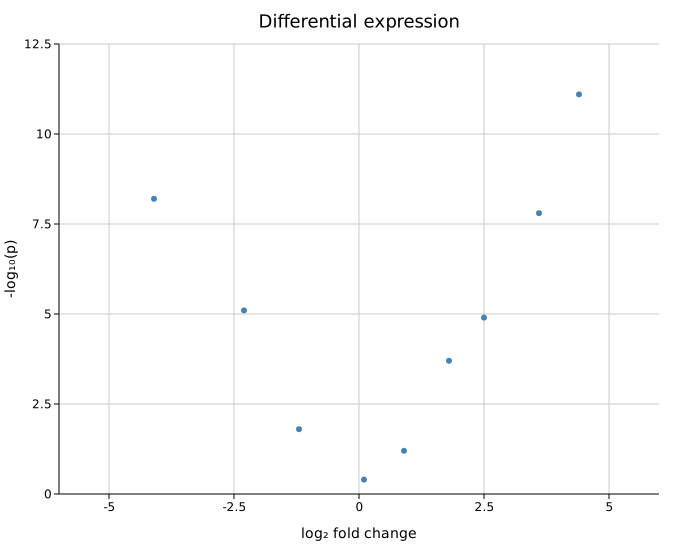
Scientific axes
$\log_2$ fold change / $-\log_{10}(p)$ — the standard RNA-seq and GWAS
axis pair:
Trigonometric labels
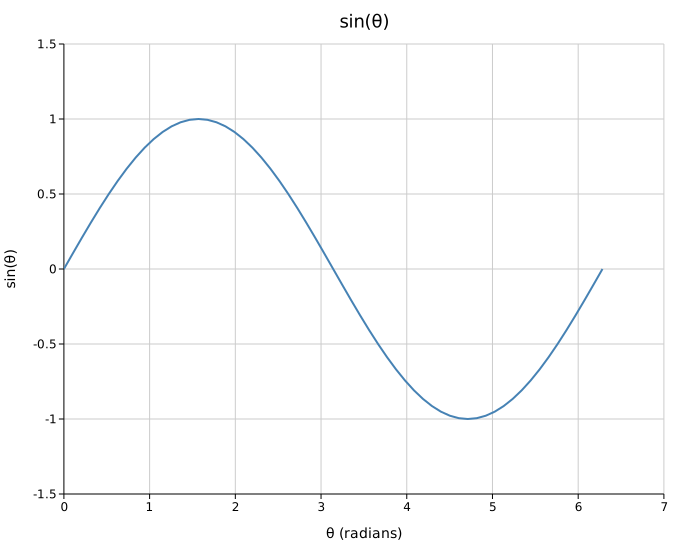
$\sin(\theta)$ in the title and y-axis label:
Exponential decay
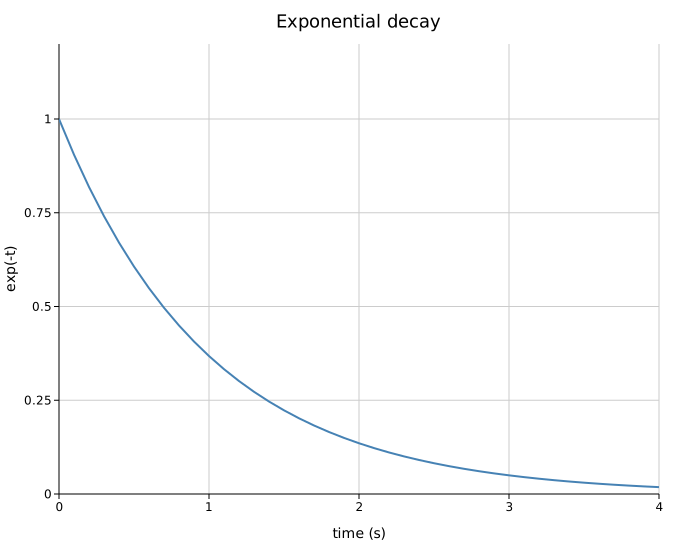
$\exp(-t)$ on the y-axis:
Greek letters and symbols
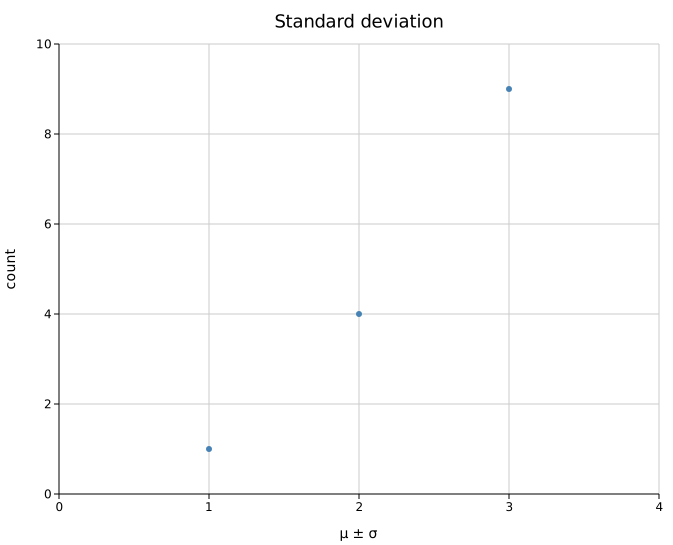
$\mu \pm \sigma$ on the x-axis:
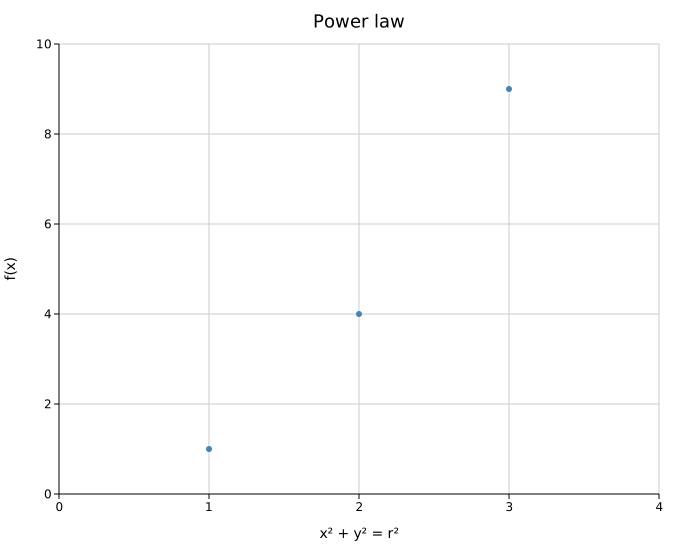
Superscripts
$x^2 + y^2 = r^2$ as the x-axis label:
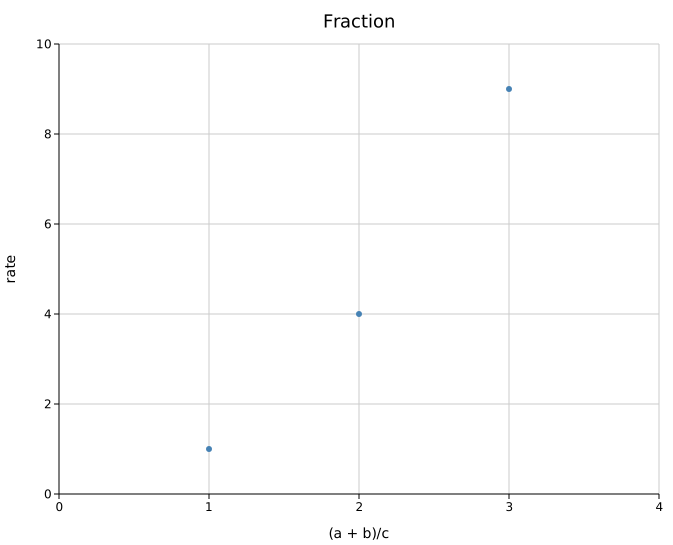
Fractions
$\frac{a+b}{c}$ → (a+b)/c:
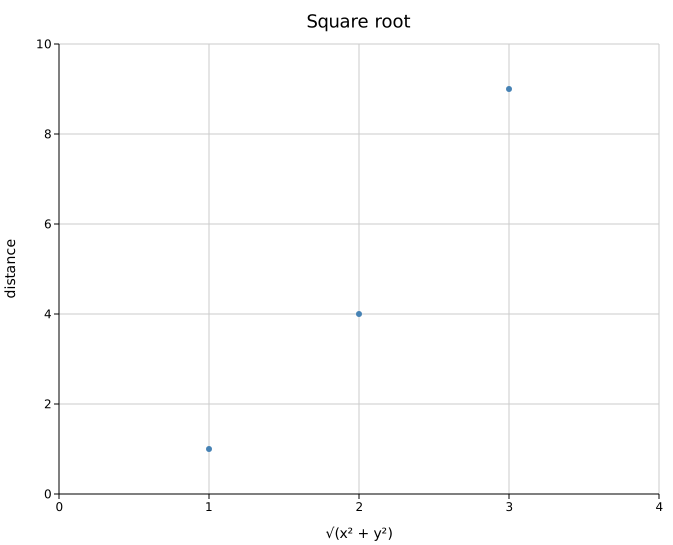
Square root
$\sqrt{x^2+y^2}$ → √(x²+y²):
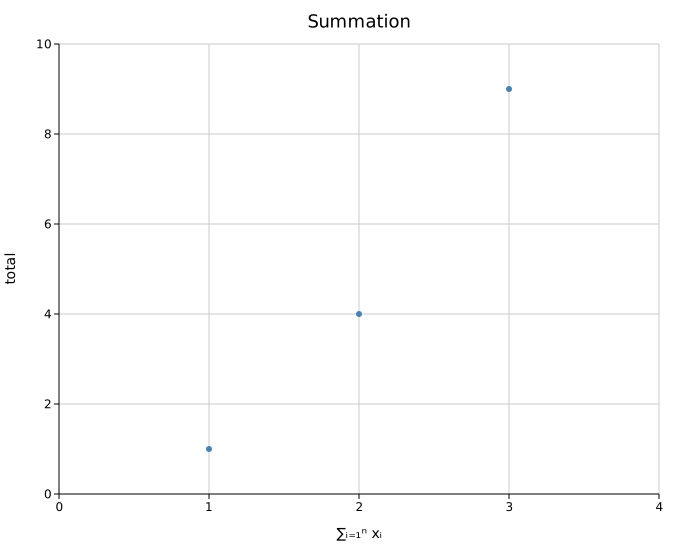
Summation with limits
$\sum_{i=1}^{n} x_i$ → ∑ᵢ₌₁ⁿ xᵢ:
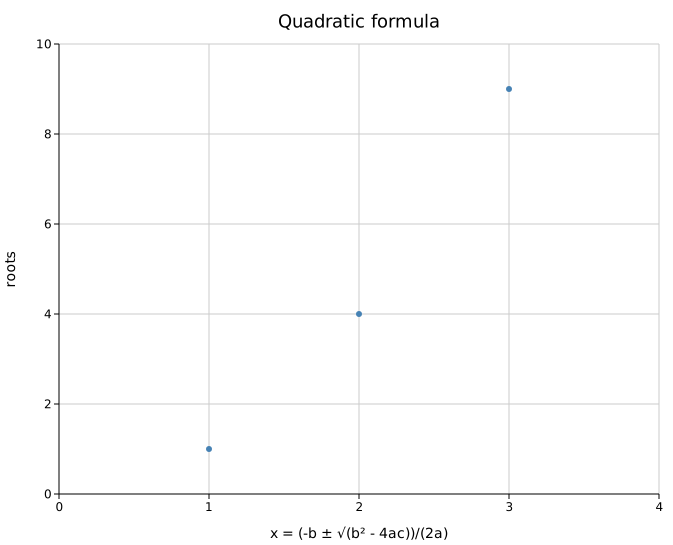
Quadratic formula
$x = \frac{-b \pm \sqrt{b^2 - 4ac}}{2a}$ → x = (-b ± √(b² - 4ac))/(2a):
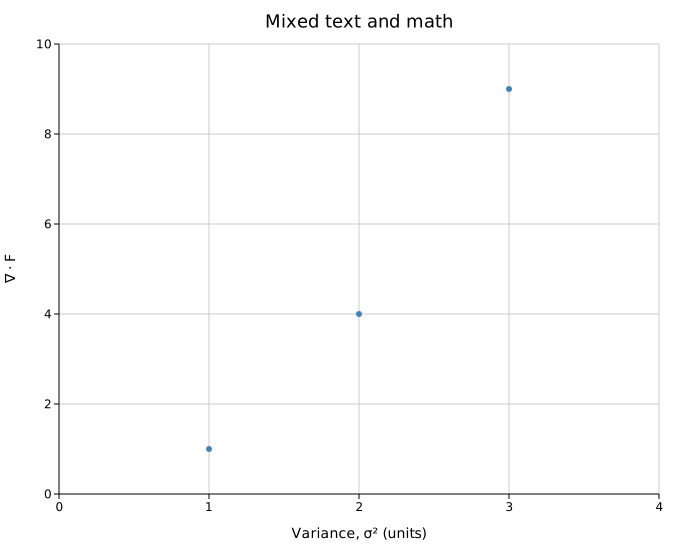
Mixed text and math
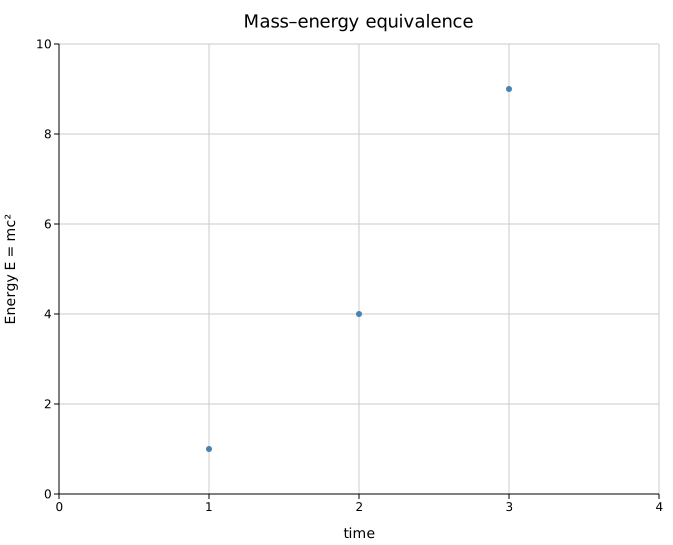
Rotated y-axis title
Energy $E = mc^2$ — math works in rotated labels too:
CLI
Math works in any label flag — no extra flags needed:
kuva scatter data.tsv \
    --x log2fc --y neg_log10_pvalue \
    --x-label '$\log_2$ fold change' \
    --y-label '$-\log_{10}(p)$' \
    --title 'Differential expression ($\alpha = 0.05$)' \
    -o volcano.svg
The same labels render in the terminal backend with --terminal — the lowered
Unicode lands directly on the character grid.
Shell quoting
$ and \ are special characters in most shells. Single quotes are the
simplest way to pass math labels literally — the shell treats everything between
'...' as plain text:
--x-label '$\log_2$ fold change' # single quotes: $ and \ are literal
If you need to interpolate a shell variable into a label that also contains math, mix quote styles:
SAMPLE="$(basename "$file" .tsv)"
--title '$\sigma^2$ for '"$SAMPLE"
#        ^^^^^^^^^^^^^^^^ literal  ^^^^^^^^^ variable expands
Or use double quotes and escape both $ and \:
--title "\$\\sigma^2\$ for $SAMPLE"
#        \$ → $,  \\ → \,  $SAMPLE → expands
On Windows (cmd.exe / PowerShell), $ and \ have no special meaning in
double-quoted strings, so no escaping is needed:
kuva scatter data.tsv --x-label "$\log_2$ fold change"