Venn Diagram
A Venn diagram displays set membership and overlap between 2, 3, or 4 groups. Each group is represented by a translucent circle (or ellipse for 4 sets), and overlapping regions show elements that belong to multiple groups simultaneously.
Venn diagrams are widely used in bioinformatics to compare gene lists from different tools, samples, or conditions — for example, the shared and unique genes identified by DESeq2, edgeR, and limma.
Import path: kuva::plot::venn::{VennPlot, VennSet, VennOverlap}
Input modes
VennPlot supports two input modes:
Raw elements — provide the actual element lists; intersections are computed automatically using set operations:
#![allow(unused)]
fn main() {
use kuva::plot::venn::VennPlot;

let venn = VennPlot::new()
    .with_set("DESeq2", vec!["BRCA1", "TP53", "MYC", "EGFR"])
    .with_set("edgeR",  vec!["TP53", "MYC", "KRAS", "PIK3CA"]);
}
Pre-computed sizes — supply the total size of each set and each intersection directly:
#![allow(unused)]
fn main() {
use kuva::plot::venn::VennPlot;

let venn = VennPlot::new()
    .with_set_size("Set A", 500)
    .with_set_size("Set B", 400)
    .with_overlap(["Set A", "Set B"], 120);
}
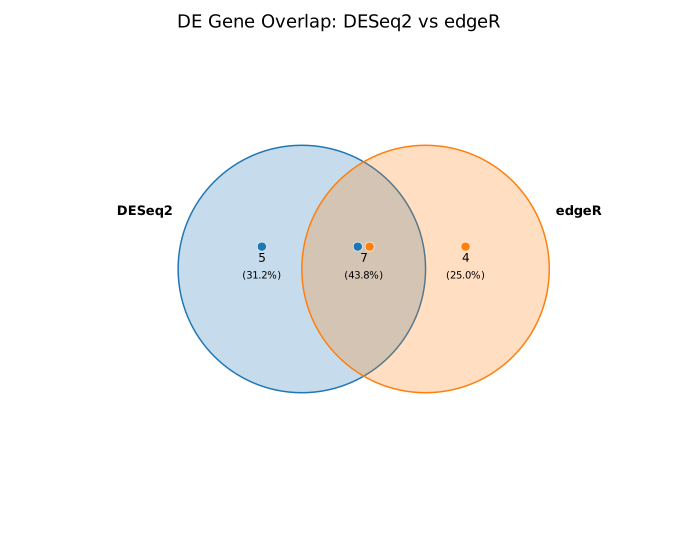
2-set diagram
#![allow(unused)]
fn main() {
use kuva::plot::venn::VennPlot;
use kuva::render::plots::Plot;
use kuva::render::layout::Layout;
use kuva::render::render::render_multiple;
use kuva::backend::svg::SvgBackend;

let deseq2 = vec!["BRCA1","TP53","MYC","EGFR","VEGFA","CDKN2A","KRAS","PTEN","MDM2","RB1"];
let edger  = vec!["TP53","MYC","KRAS","PIK3CA","PTEN","RB1","AKT1","MTOR","CDK4"];

let venn = VennPlot::new()
    .with_set("DESeq2", deseq2.iter().map(|s| s.to_string()).collect())
    .with_set("edgeR",  edger.iter().map(|s| s.to_string()).collect())
    .with_percentages(true);

let plots = vec![Plot::Venn(venn)];
let layout = Layout::auto_from_plots(&plots).with_title("DE Gene Overlap");
let scene = render_multiple(plots, layout);
let svg = SvgBackend.render_scene(&scene);
std::fs::write("venn_2set.svg", svg).unwrap();
}
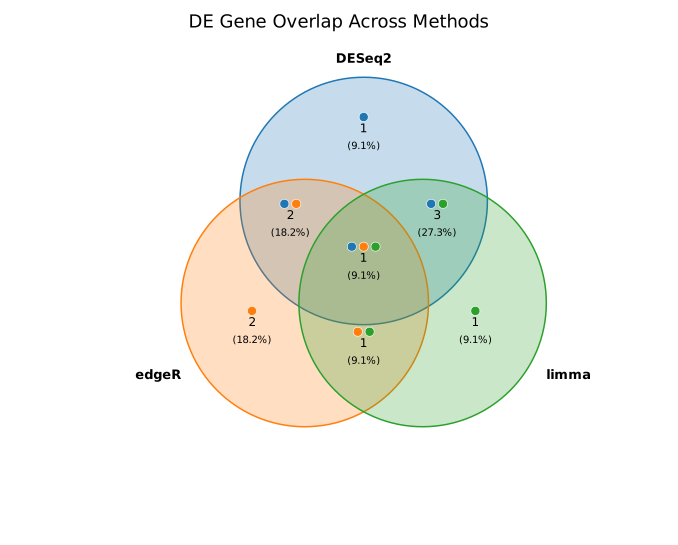
3-set diagram
Three circles are arranged in an equilateral triangle. All 7 regions (unique to each set, pairwise overlaps, and the triple overlap) are labeled.
#![allow(unused)]
fn main() {
use kuva::plot::venn::VennPlot;
use kuva::render::plots::Plot;

let deseq2 = vec!["BRCA1","TP53","MYC","EGFR","VEGFA","CDKN2A","KRAS"];
let edger  = vec!["TP53","MYC","KRAS","PIK3CA","PTEN","RB1"];
let limma  = vec!["BRCA1","MYC","EGFR","PIK3CA","CDKN2A","MDM2"];

let venn = VennPlot::new()
    .with_set("DESeq2", deseq2.iter().map(|s| s.to_string()).collect())
    .with_set("edgeR",  edger.iter().map(|s| s.to_string()).collect())
    .with_set("limma",  limma.iter().map(|s| s.to_string()).collect())
    .with_counts(true)
    .with_percentages(true);
}
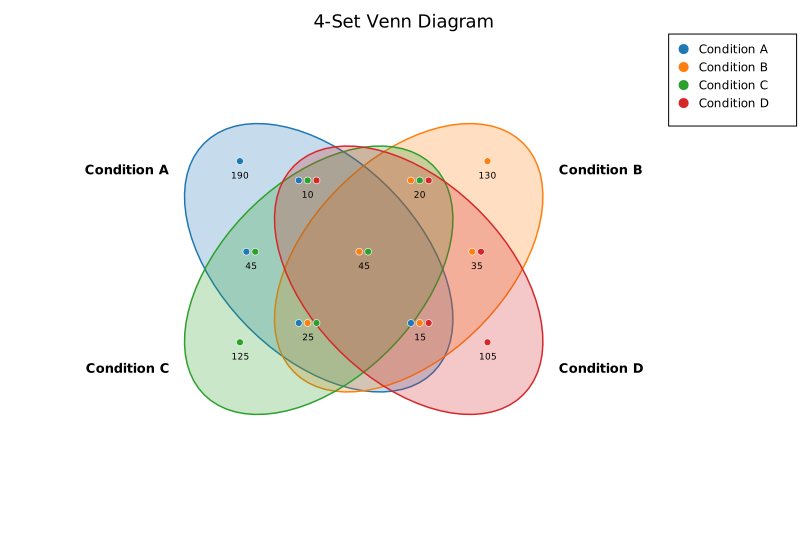
4-set diagram
Four-set Venns use rotated ellipses in a symmetric arrangement, producing all 15 non-empty regions. Proportional mode is not supported for 4-set diagrams.
#![allow(unused)]
fn main() {
use kuva::plot::venn::VennPlot;

let venn = VennPlot::new()
    .with_set_size("Condition A", 400)
    .with_set_size("Condition B", 350)
    .with_set_size("Condition C", 300)
    .with_set_size("Condition D", 250)
    .with_overlap(["Condition A", "Condition B"], 120)
    .with_overlap(["Condition A", "Condition C"], 90)
    // ... all pairwise, triple, and quadruple overlaps ...
    .with_overlap(["Condition A", "Condition B", "Condition C", "Condition D"], 10)
    .with_counts(true);
}
Proportional mode
Enable .with_proportional(true) to scale circle areas proportional to set sizes. The renderer uses binary search to find center-to-center distances that approximate the target intersection areas using the lens-area formula.
#![allow(unused)]
fn main() {
use kuva::plot::venn::VennPlot;

let venn = VennPlot::new()
    .with_set_size("Proteomics",      850)
    .with_set_size("Transcriptomics", 1200)
    .with_set_size("Metabolomics",    600)
    .with_overlap(["Proteomics", "Transcriptomics"], 320)
    .with_overlap(["Proteomics", "Metabolomics"],    180)
    .with_overlap(["Transcriptomics", "Metabolomics"], 250)
    .with_overlap(["Proteomics", "Transcriptomics", "Metabolomics"], 90)
    .with_proportional(true)
    .with_loss(true);
}
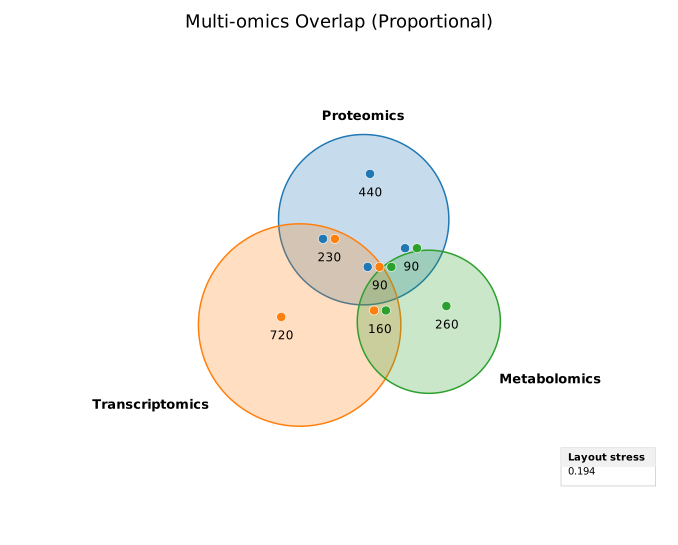
Note: proportional mode is supported for 2 and 3 sets only.
API reference
| Method | Description |
|---|---|
with_set(label, elements) | Add a set from a raw element list. |
with_set_size(label, size) | Add a set with a pre-computed total size. |
with_overlap(labels, size) | Pre-computed intersection size for 2+ sets. |
with_counts(bool) | Show element counts in each region (default: true). |
with_percentages(bool) | Show percentage of total in each region (default: false). |
with_set_labels(bool) | Show set name labels (default: true). |
with_fill_opacity(f64) | Fill opacity for circles/ellipses (default: 0.25). |
with_stroke_width(f64) | Outline stroke width (default: 1.5). |
with_proportional(bool) | Scale circles proportionally to set sizes (default: false). |
with_loss(bool) | Display layout stress score in proportional mode (default: false). |
with_colors(iter) | Override colors per set (CSS color strings). |
with_legend(label) | Attach a legend with one entry per set. |
See also: UpSet Plot for set intersections beyond 4 sets, Mosaic Plot for proportional two-way categorical tables.
CLI
Venn diagram — 2–4 overlapping sets with intersection counts labeled in each region.
Input: one row per element–set membership pair (element column + set column). Intersections are computed automatically.
| Flag | Default | Description |
|---|---|---|
--element-col <COL> | 0 | Element/item column |
--set-col <COL> | 1 | Set name column |
--proportional | off | Scale circle areas proportional to set sizes |
--no-set-labels | off | Hide set name labels |
--fill-opacity <F> | 0.25 | Circle fill opacity |
--legend <LABEL> | — | Add a legend |
kuva venn data.tsv --element-col gene --set-col set

kuva venn data.tsv --element-col gene --set-col pathway \
    --proportional --legend "Gene Sets" \
    --title "Pathway Overlap"
Note: supports 2, 3, or 4 sets. More than 4 sets are not supported.
See also: Shared flags — output, appearance.